

Whats the difference between SOG and STW?
Lets study!
STW vs SOG: Key Differences for Mariners
If you’ve ever worked on a ship, you’ve almost certainly seen two critical speed readings:
STW (Speed Through Water) and SOG (Speed Over Ground).While both show speed, they measure completely different things — and confusing them can lead to costly navigation errors.
Let’s break them down clearly, once and for all.
STW – Speed Through Water
Definition: STW is the speed of the vessel relative to the surrounding water only.
How It’s Measured
Usually obtained from a ship’s log, impeller, or electromagnetic sensor.
These devices measure how fast the hull moves through the water itself. What It Tells You
- The true performance of the ship’s engines and propellers.
- Used for steering, collision avoidance, and manoeuvring.
Effect of Current
STW does NOT include the effect of tides, currents, or wind.
If the water itself moves, the STW reading stays the same.
SOG – Speed Over Ground
Definition
SOG is the vessel’s actual speed relative to the Earth’s surface or seabed.
How It’s Measured
From GPS, GNSS, or other position-fixing systems.
What It Tells You
- The real speed made good over the ground.
- Used for navigation, course planning, ETA (Estimated Time of Arrival) calculations, and track monitoring.
Effect of Current
SOG includes everything: current, wind, drift, leeway — so it shows your true progress over the seabed.
Why Do STW and SOG Differ?
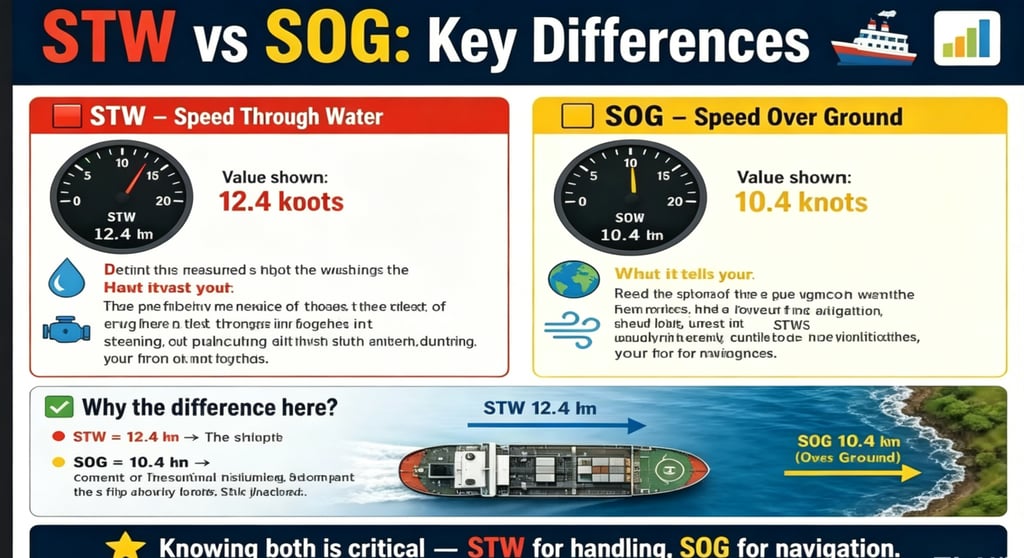
Take this example from the infographic:
- STW = 12.4 knots → The ship is pushing through the water at 12.4 knots.
- SOG = 10.4 knots → A counter-current or headwind is slowing the ship down by about 2 knots relative to land.
The water is moving against the vessel, so even though the engines are pushing at 12.4 knots, the vessel only makes 10.4 knots of progress over the ground.
Quick Rule to Remember
STW SOG
Engine / Water speed Actual / Ground speed
- STW = how fast the ship is moving through the water.
- SOG = how fast the ship is moving over the Earth.
Final Takeaway
Knowing both speeds is critical for safe and efficient navigation:
- Use STW for handling, manoeuvring, and understanding engine performance.
- Use SOG for navigation, route planning, and ETA calculations.